MCP deprecation deadline: about 28 July 2027

Your agents cast spells they found on the internet. Someone should check them.

Spellwarden scans the skills and MCP servers your AI agents load, turns findings into policy at your gateways and hooks, measures quality with evals, and shows what your agents actually use at runtime.

See the live demo
A working organisation, read-only, no account needed.

Start a 14-day trial

No card needed.

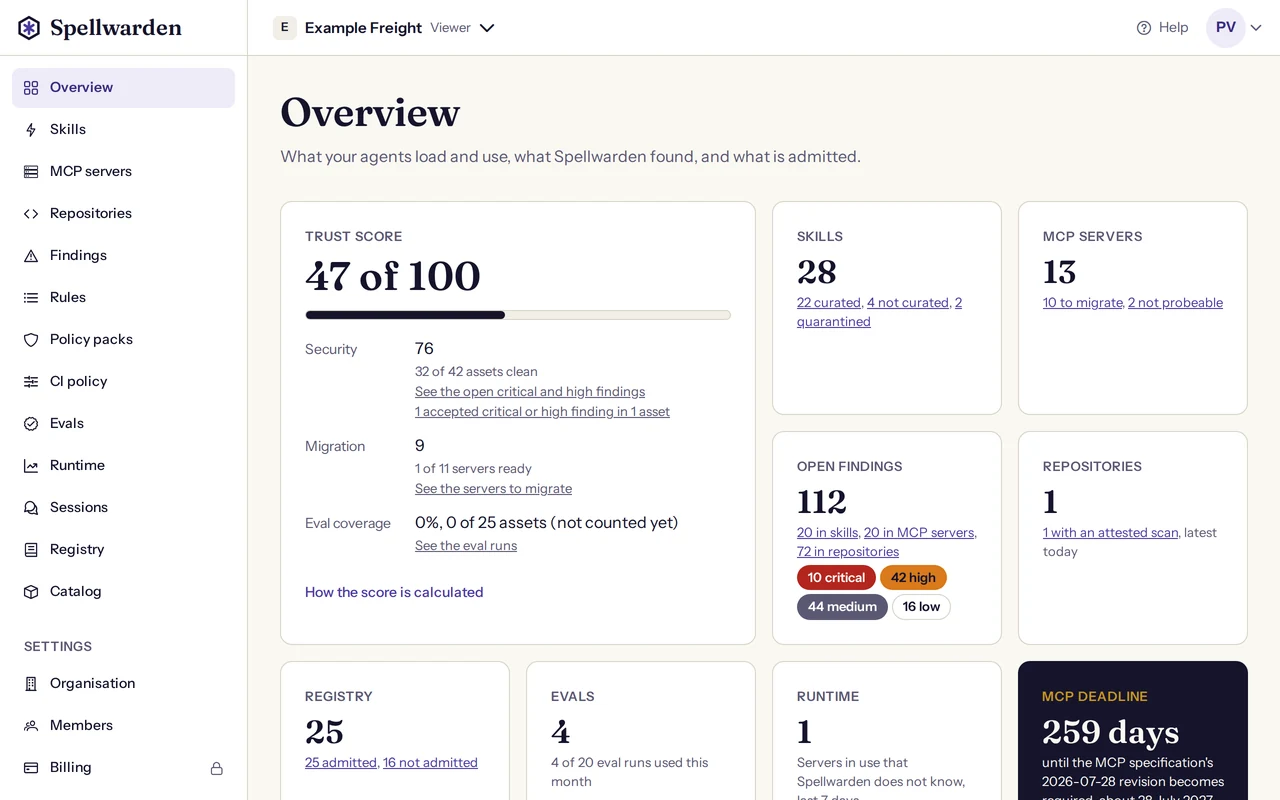
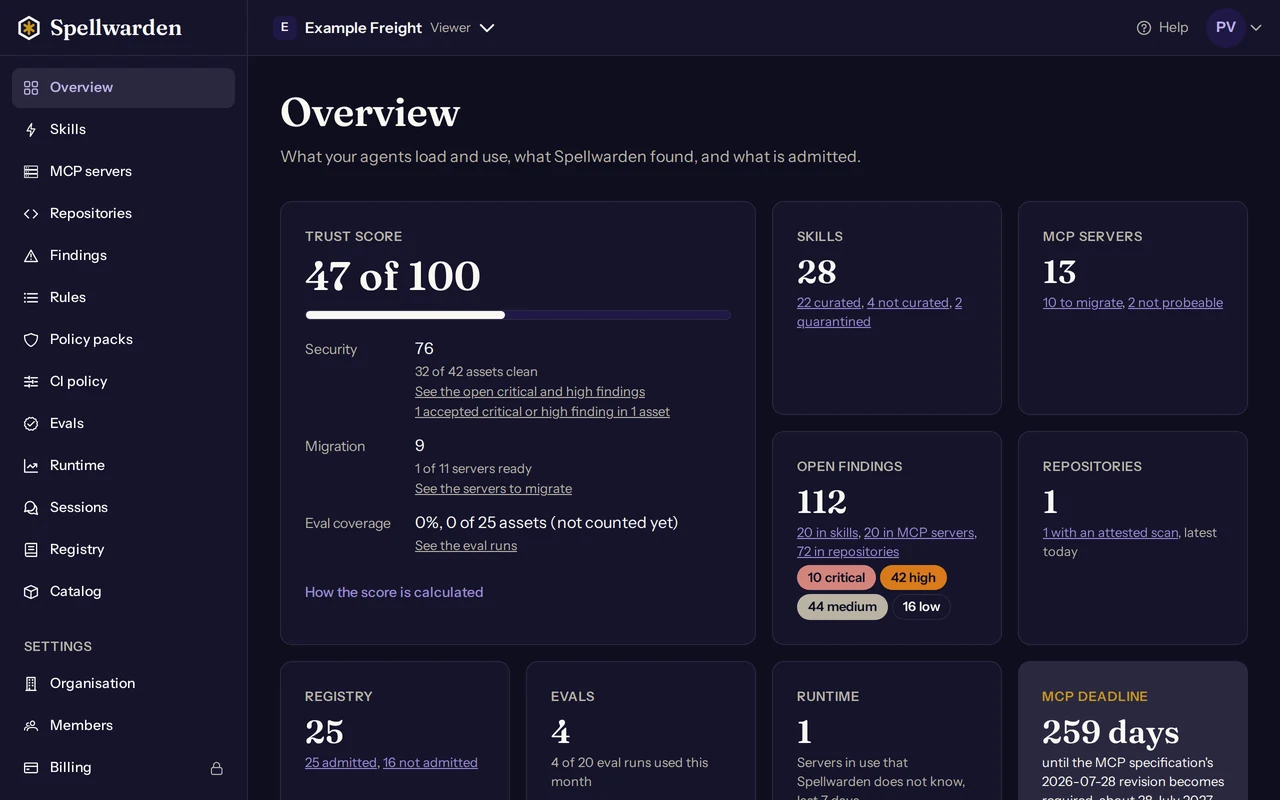
Overview of an organisation: a trust score of 47 of 100, 28 skills, 13 MCP servers and 112 open findings in skills, MCP servers and repositories, by severity, each count a link to its itemsOverview of an organisation: a trust score of 47 of 100, 28 skills, 13 MCP servers and 112 open findings in skills, MCP servers and repositories, by severity, each count a link to its items

The trust score, open findings, evals and what your registry admits, on one page.

  • 36.8% of public skills scanned had at least one issue
  • 76 confirmed malicious skills across ClawHub and the skills.sh top 100
  • 38.7% of production MCP servers run with no authentication
  • 29.5% of teams run no evals at all
  • +15.0 points on 40 infrastructure tasks with Infra Pack 0.9.0, over five measured runs, graded by Claude Opus 5.5

Sources: Snyk ToxicSkills study, February 2026; Bloomberry scan of company-operated MCP servers, February 2026; LangChain survey; Spellwarden, Infra Pack MEASUREMENTS.md, October 2026.

Works with the tools you already run

Agents
Claude Code, Claude (web, desktop and mobile, through the connector), AWS DevOps Agent, Cursor, VS Code
CI
GitHub Actions (github.com, GitHub Enterprise Cloud and Server), GitLab CI (gitlab.com and self-managed), any other CI through the command line
Enforcement
Claude Code hooks, Kong, Zuplo MCP Gateway
Evals
AWS AgentCore Evaluations, Microsoft Foundry, Outcomes in Claude Managed Agents
Telemetry
OpenTelemetry (OTLP over HTTP)

Scanning, policy, evals and a private registry

Four modules, one grimoire

Each module feeds the next. A scan produces omens, omens become wards, trials grade spells, and only what passes is inscribed in your grimoire.

In plain terms: scans produce findings, findings become policy, evals measure quality, and only what passes enters your private registry.

Ward

Policy Packs

Rule packs mapped to OWASP and NIST, exported to Claude Code hooks, Kong and Zuplo. Enforced where you already enforce.

Trial

Evals

Vendor-neutral eval suites and judge rubrics, exported to AgentCore Evaluations, Microsoft Foundry and Outcomes in Claude Managed Agents, and runtime evidence from your agents' OpenTelemetry traces and logs. Prove a skill pack's lift before you ship it.

Grimoire

MCP Migrate and Registry

A private registry on the open MCP registry spec. Only curated, auth-enabled entries, migrated or within their grace period, are admitted, and pull and merge requests are checked against it.

Scry: Skill Verify

Know what your agents load before they load it.

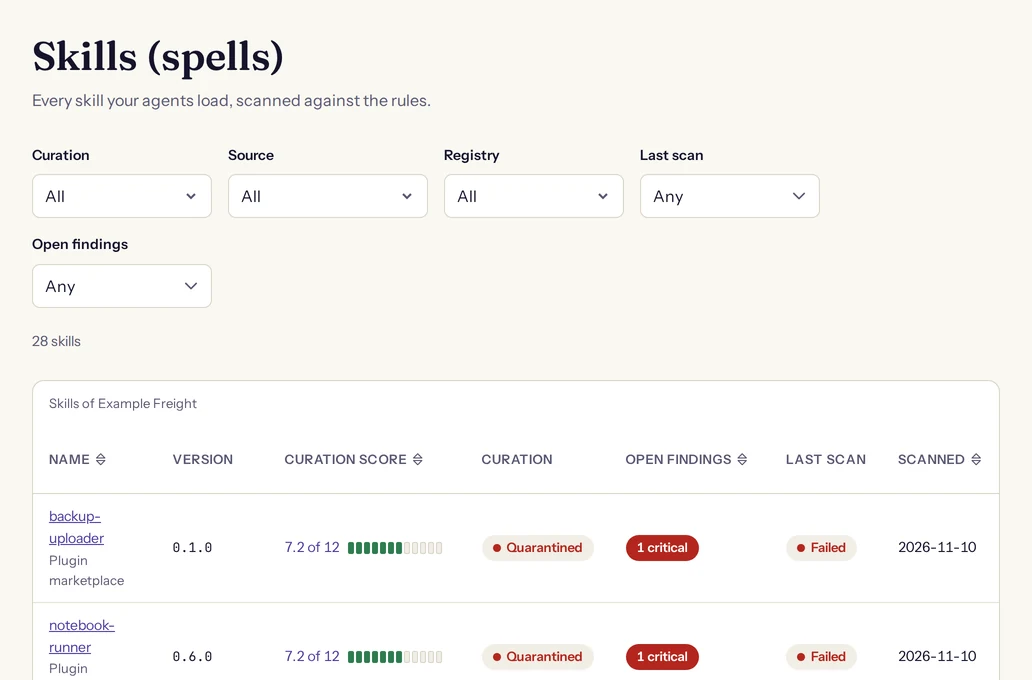
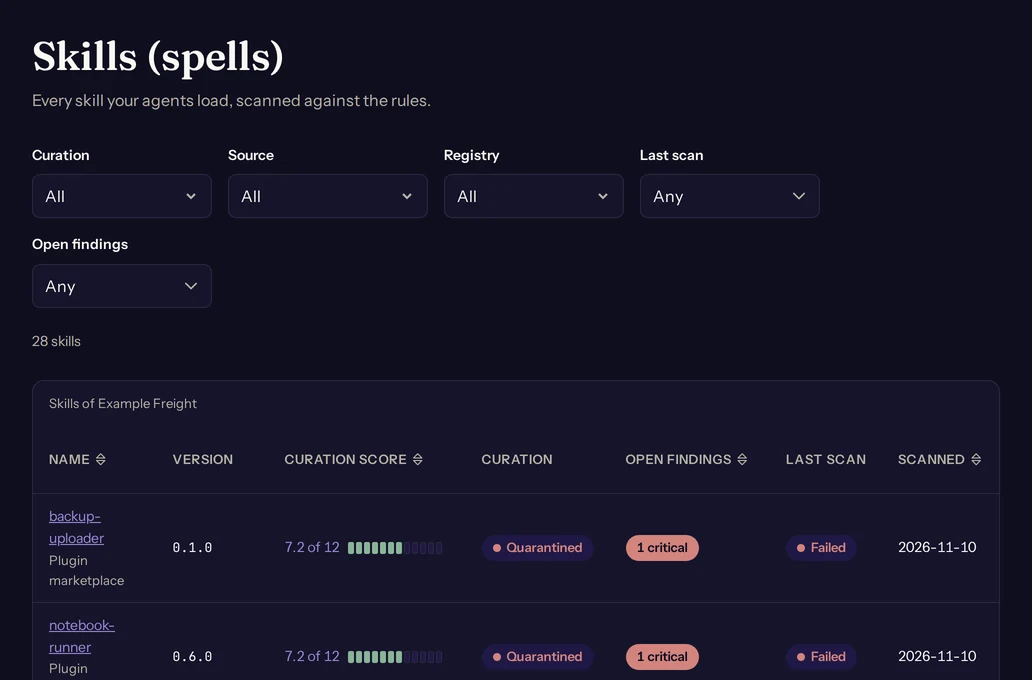
Spellwarden checks every skill, MCP server and A2A agent card your agents use, from a zip, a repository, skills.sh, a Claude Code plugin marketplace or the official MCP registry. Each version is pinned by its hash and scored.

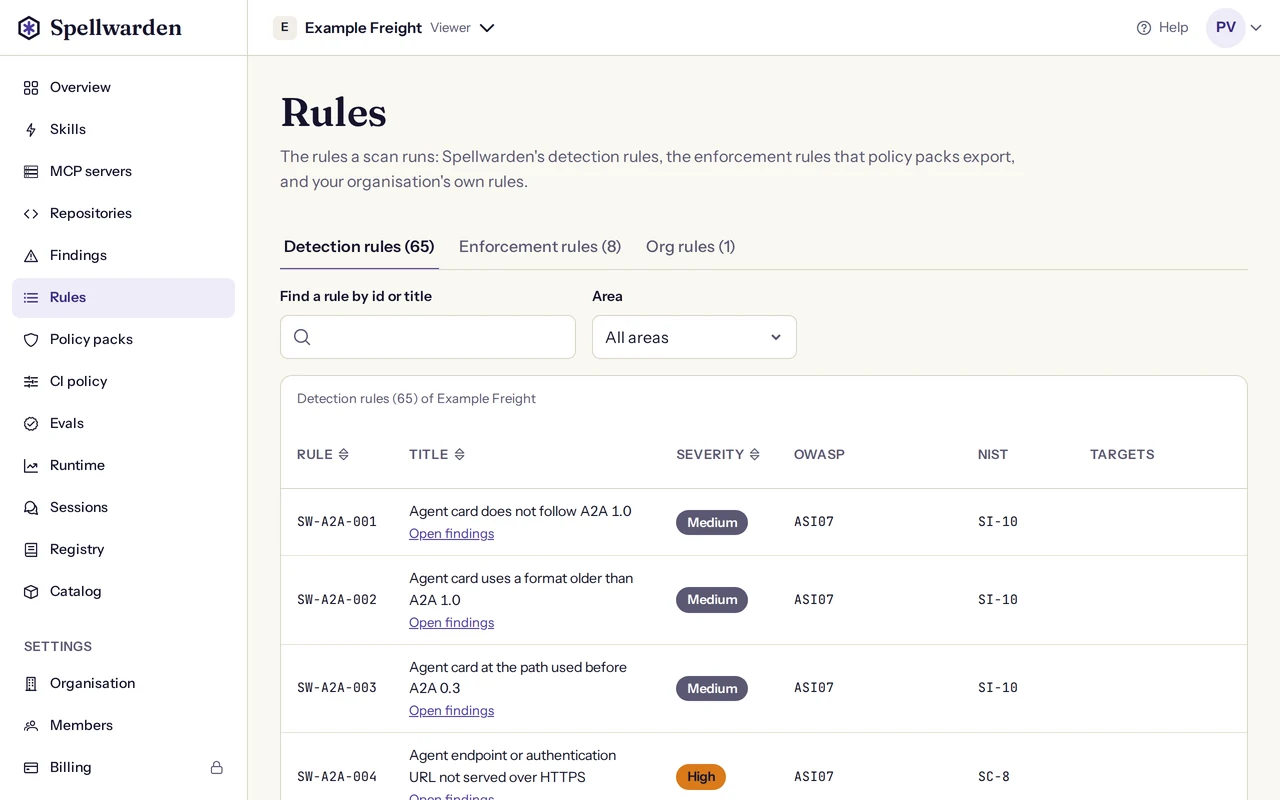
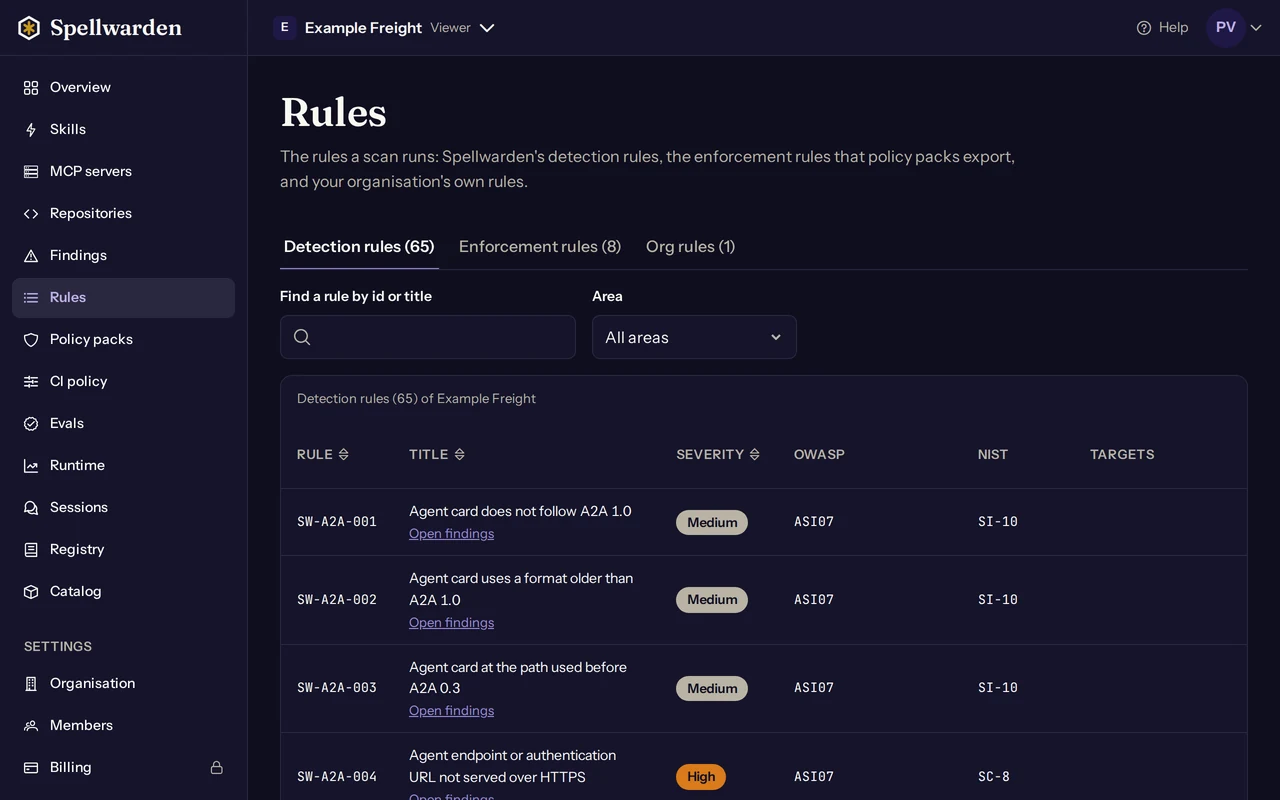
  • 65 rules mapped to the OWASP Agentic Top 10, the OWASP MCP Top 10 and NIST SP 800-53
  • A curation score from 0 to 12, and the Curated badge at 8 or more with no open critical or high finding
  • Skills and servers rescanned every week; repositories report from their own CI
  • Connected pipelines prove which repository they run for with the code host's signed token, so no long-lived secret is needed
Scanned skills, worst first, with filters by curation, source, registry, last scan and open findings, each with its version, curation score out of 12, curation state, open findings and last scanScanned skills, worst first, with filters by curation, source, registry, last scan and open findings, each with its version, curation score out of 12, curation state, open findings and last scan

Ward: Policy Packs

Turn findings into policy where you already enforce it.

A manager promotes a finding into an organisation rule. Policy packs bundle enforcement rules into versions you export to the places your agents run.

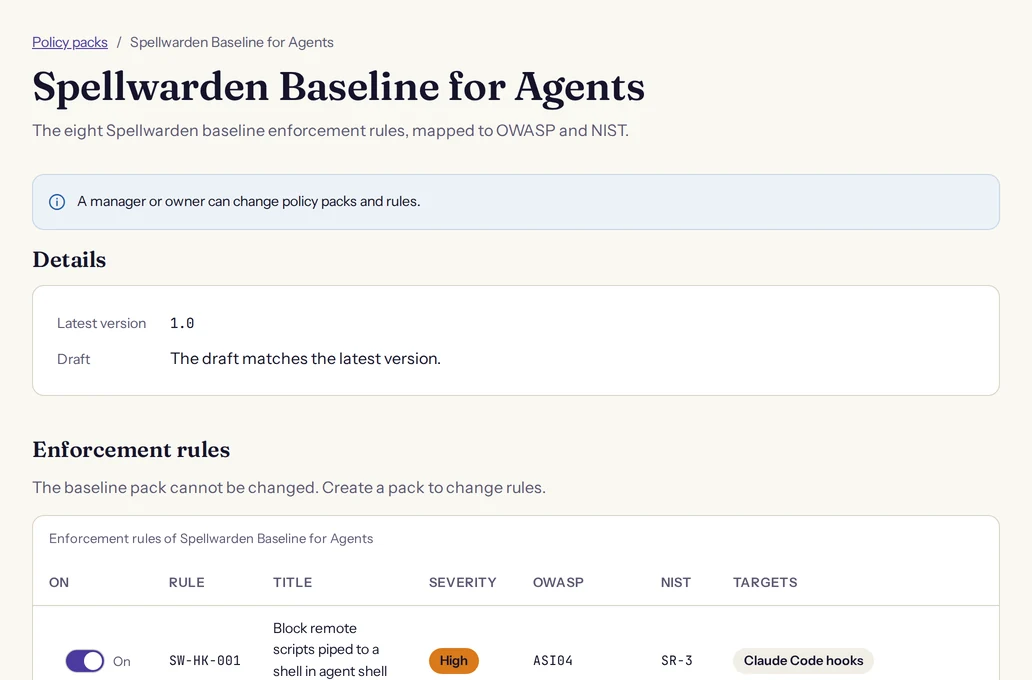
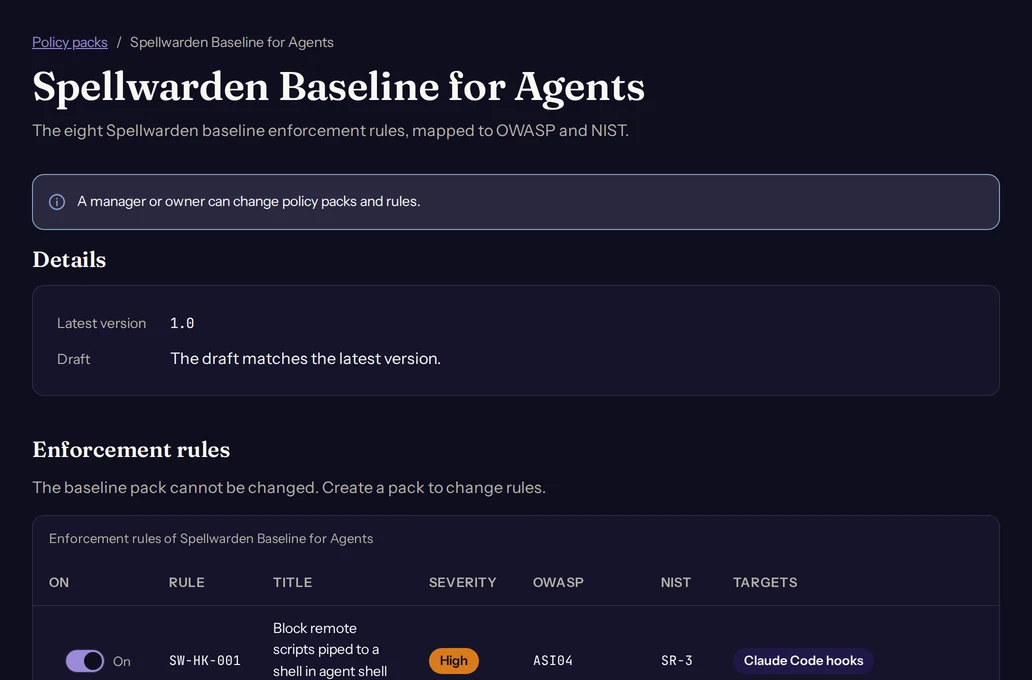
  • The baseline pack: eight enforcement rules mapped to OWASP and NIST
  • Exports to Claude Code hooks, Kong and Zuplo MCP Gateway, each listing what it cannot enforce
  • Your own packs, with published versions that never change
  • One CI policy: which rules pipelines apply and which packs a repository may choose
The Spellwarden Baseline for Agents policy pack, with its eight enforcement rules, their severity, OWASP and NIST references and targetsThe Spellwarden Baseline for Agents policy pack, with its eight enforcement rules, their severity, OWASP and NIST references and targets

Trial: Evals

Prove a skill helps before you roll it out.

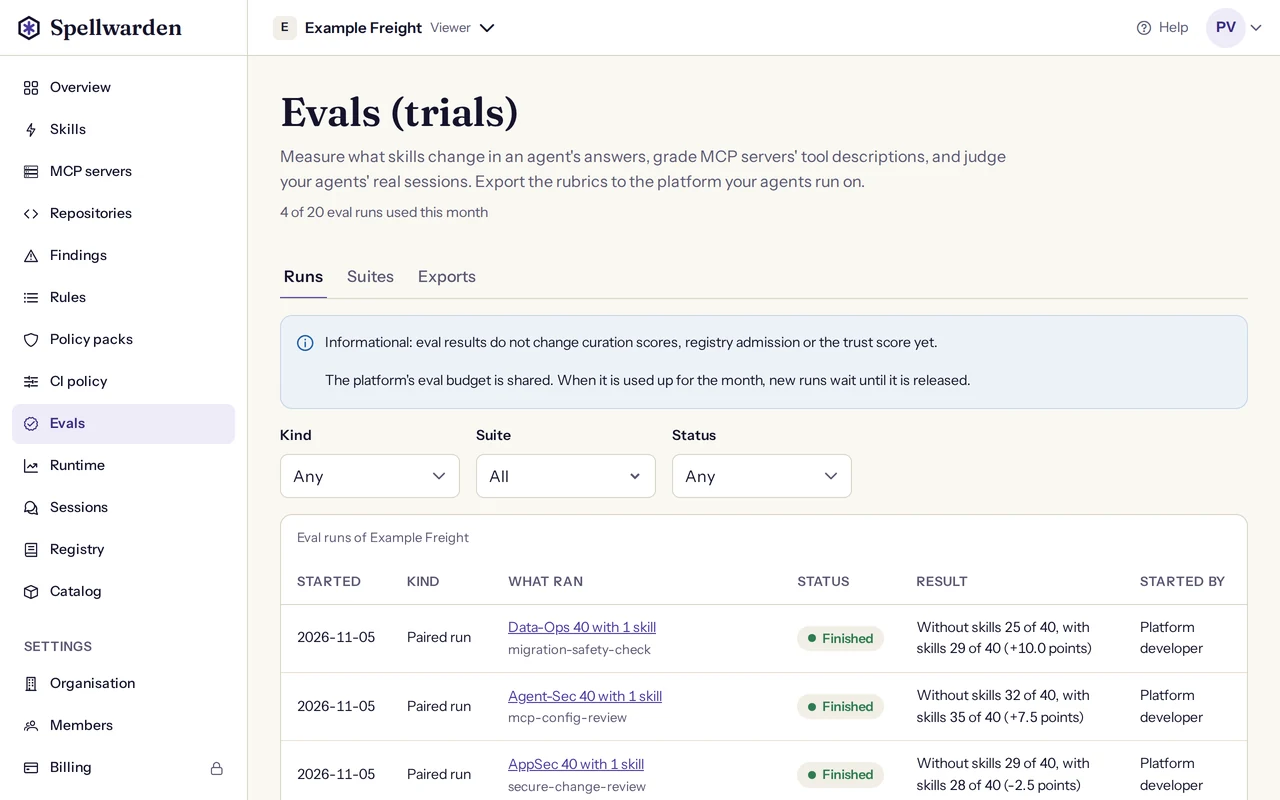
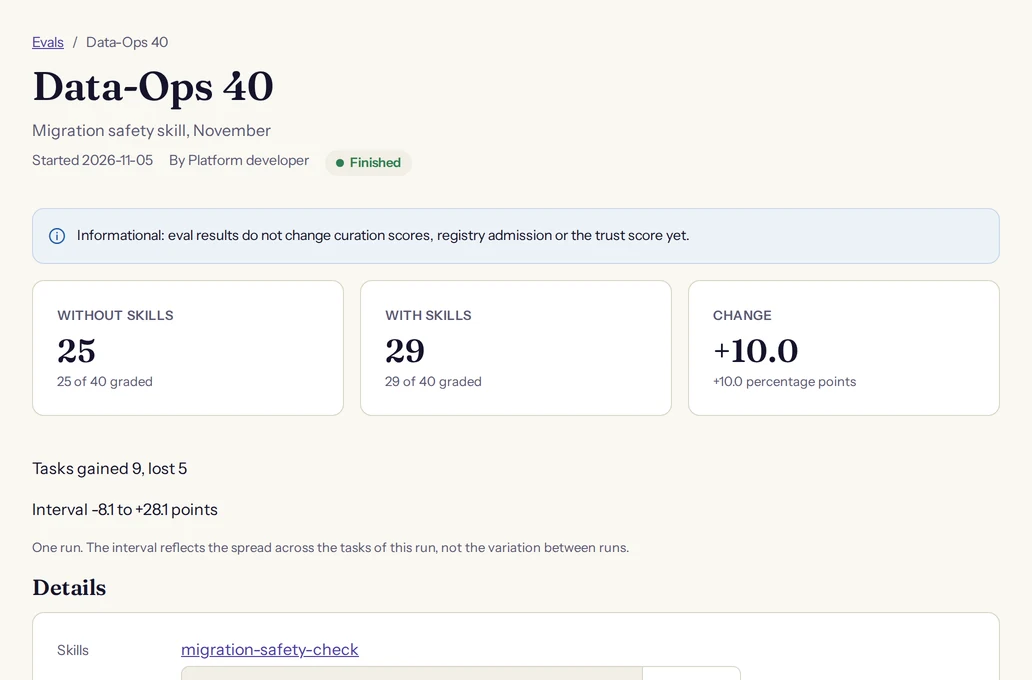
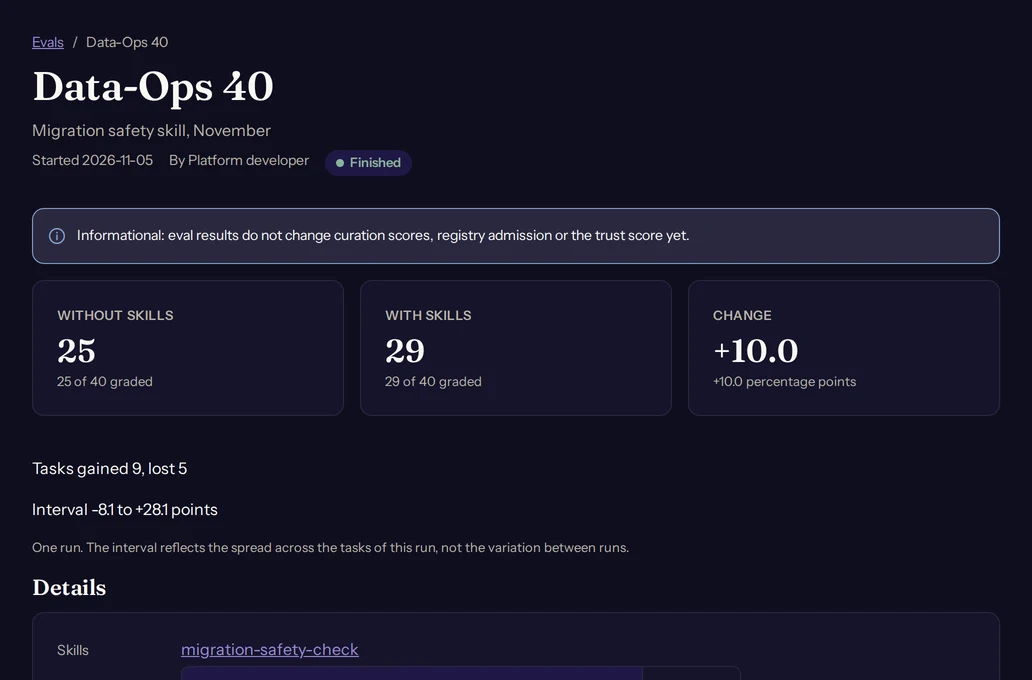
A paired run answers the same tasks with and without your skills and reports the change in points, with an interval. Results stay informational until a suite is calibrated, and each suite shows its calibration status.

  • Four sealed suites of 40 tasks: Infra-Ops, AppSec, Agent-Sec and Data-Ops
  • Grades for an MCP server's tool descriptions, from A to F
  • Grades for real agent sessions from your runtime traces, on six criteria
  • Exports of rubrics and practice tasks to AWS AgentCore Evaluations, Microsoft Foundry and Outcomes in Claude Managed Agents, pushed without a stored secret
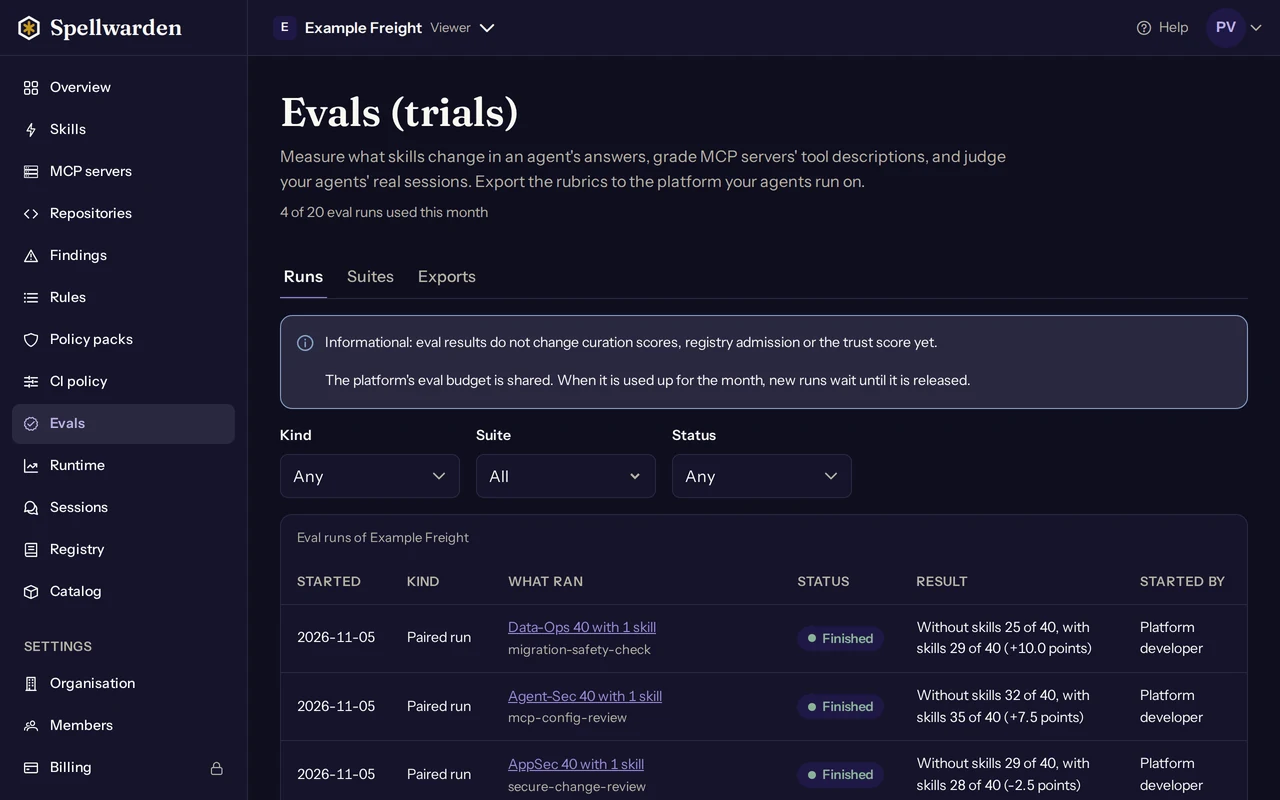
A paired eval run on the Data-Ops 40 suite: 25 of 40 tasks without skills, 29 of 40 with skills, a change of plus 10.0 pointsA paired eval run on the Data-Ops 40 suite: 25 of 40 tasks without skills, 29 of 40 with skills, a change of plus 10.0 points

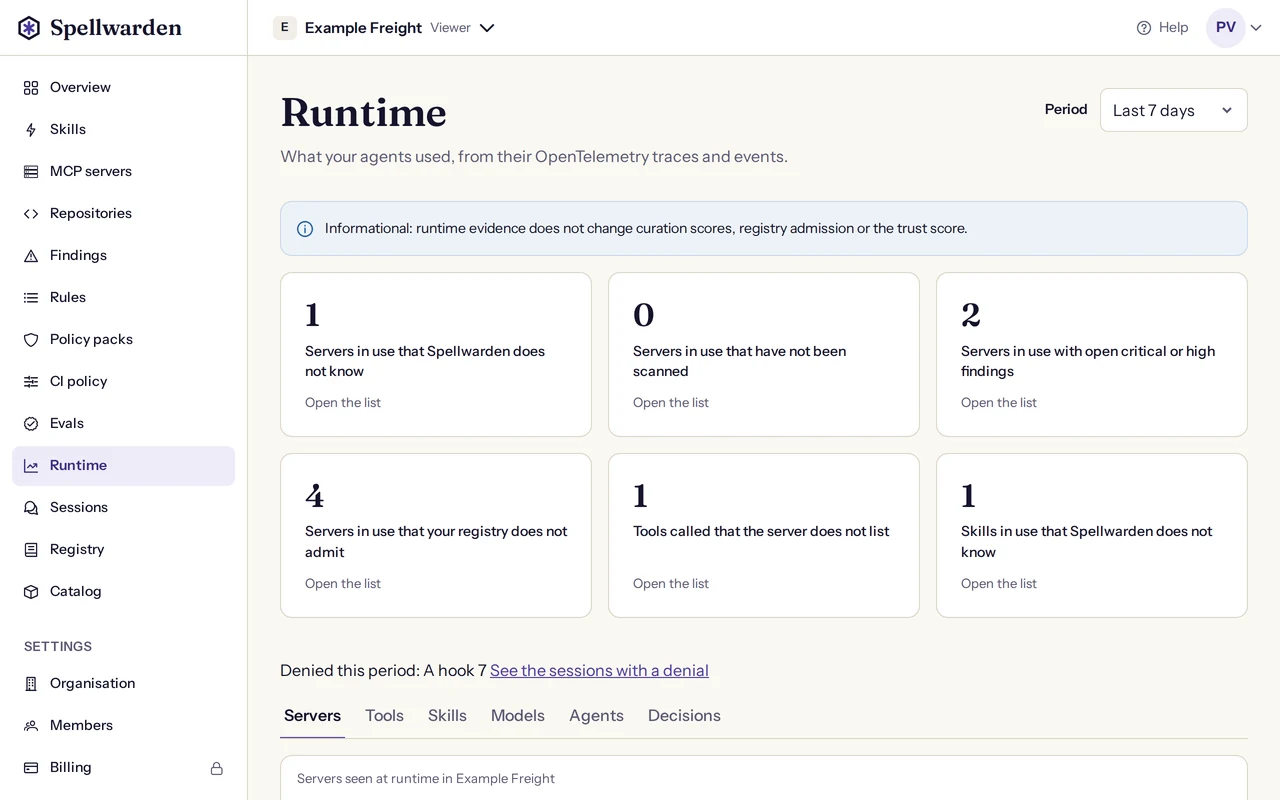
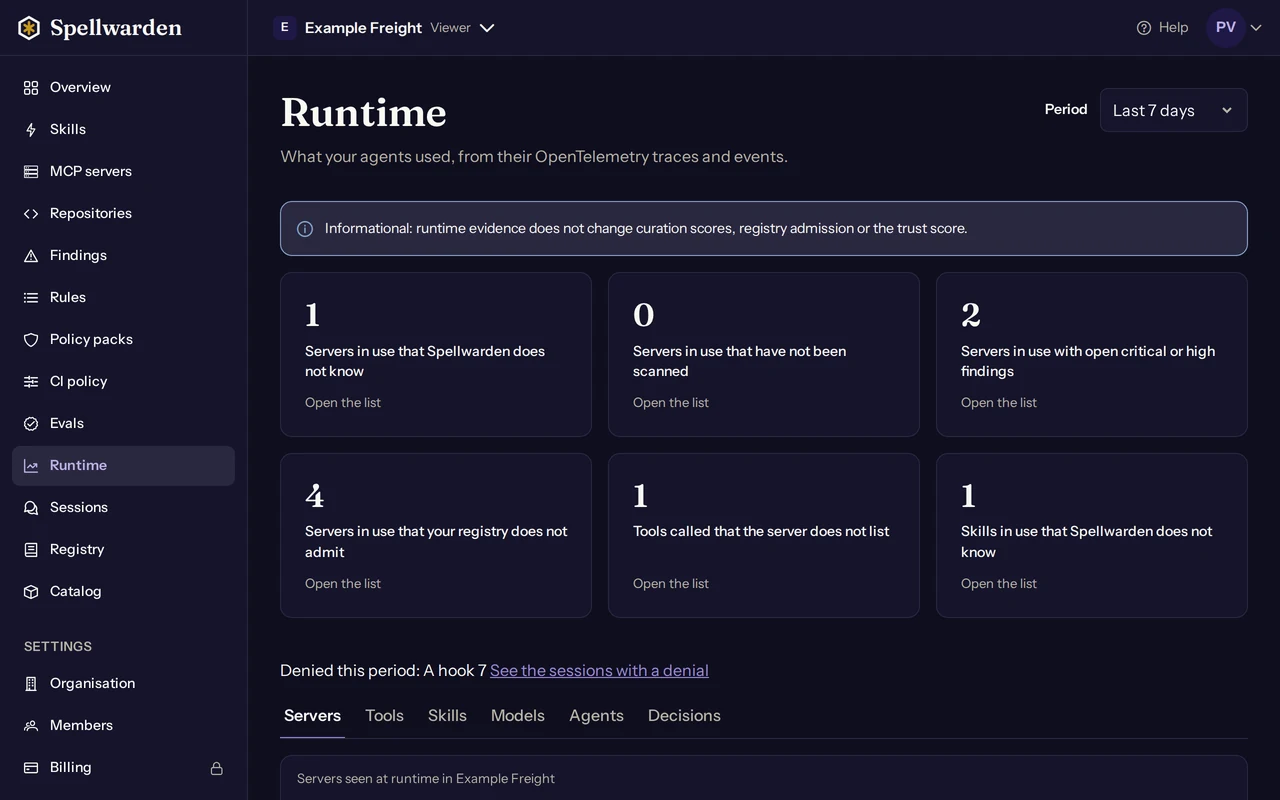
Runtime

See what your agents actually use.

Send OpenTelemetry traces and logs from Claude Code, the Claude Platform or any OpenTelemetry SDK. Spellwarden matches every server, tool, skill and model to your scans and findings.

  • Servers and skills in use that Spellwarden does not know, has not scanned, or found critical or high issues in
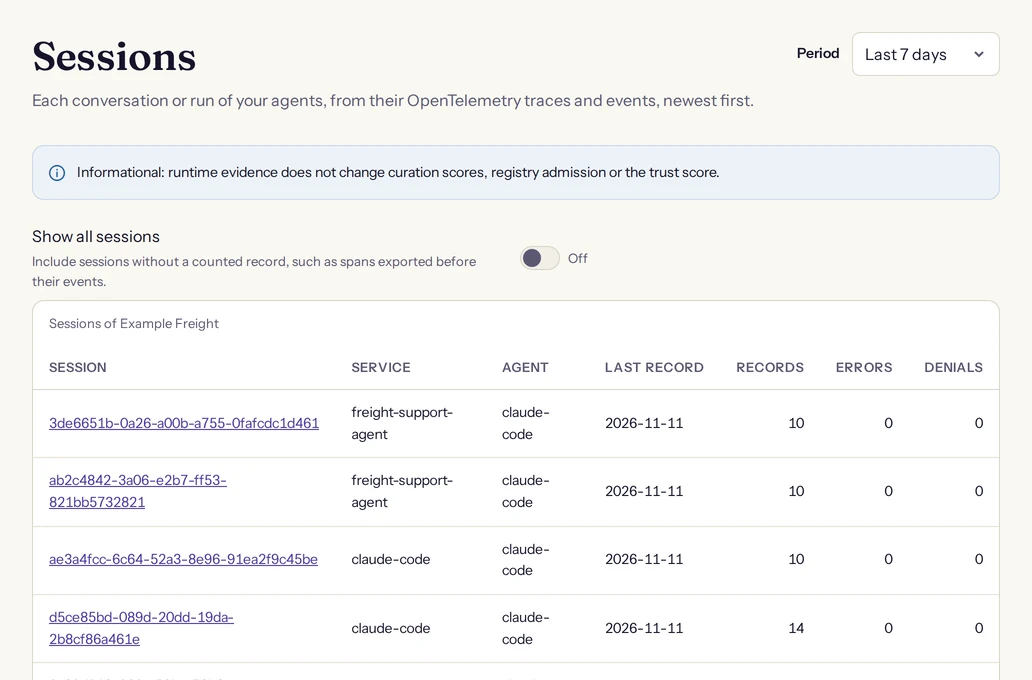
  • Sessions shown step by step: agent, model, tool and decision
  • Prompts and tool arguments kept only if an owner turns it on, masked, for 30 days
  • 2 million records a month on Team, 20 million on Enterprise
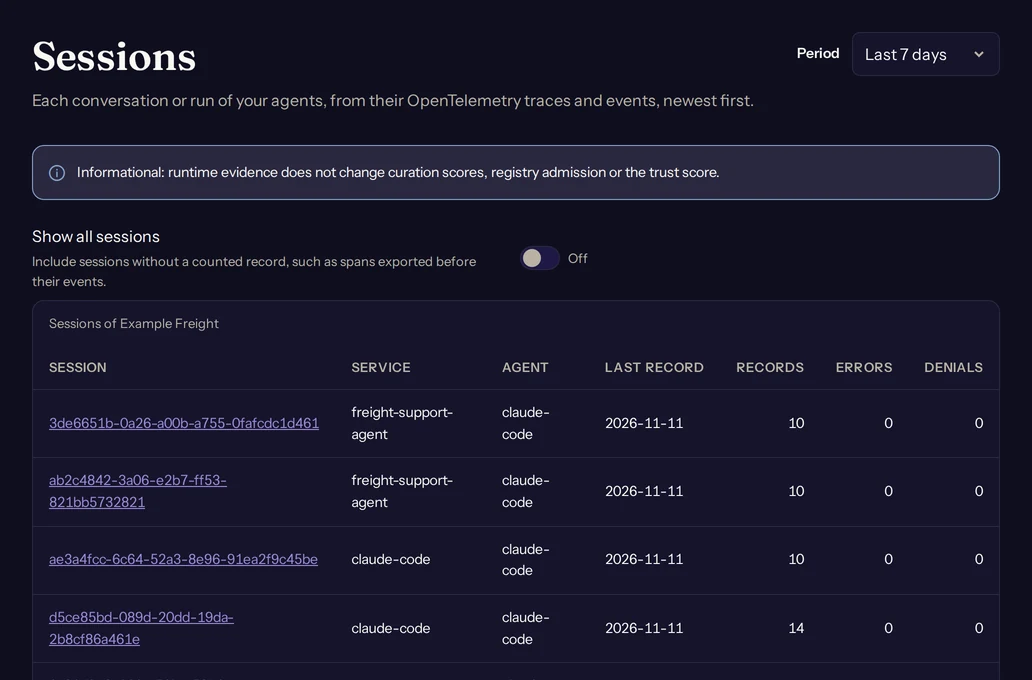
Sessions of agents, each a conversation or run with its service, agent, last record, records, errors and denialsSessions of agents, each a conversation or run with its service, agent, last record, records, errors and denials

Grimoire: MCP Migrate and Registry

Admit only what passes, and migrate what does not.

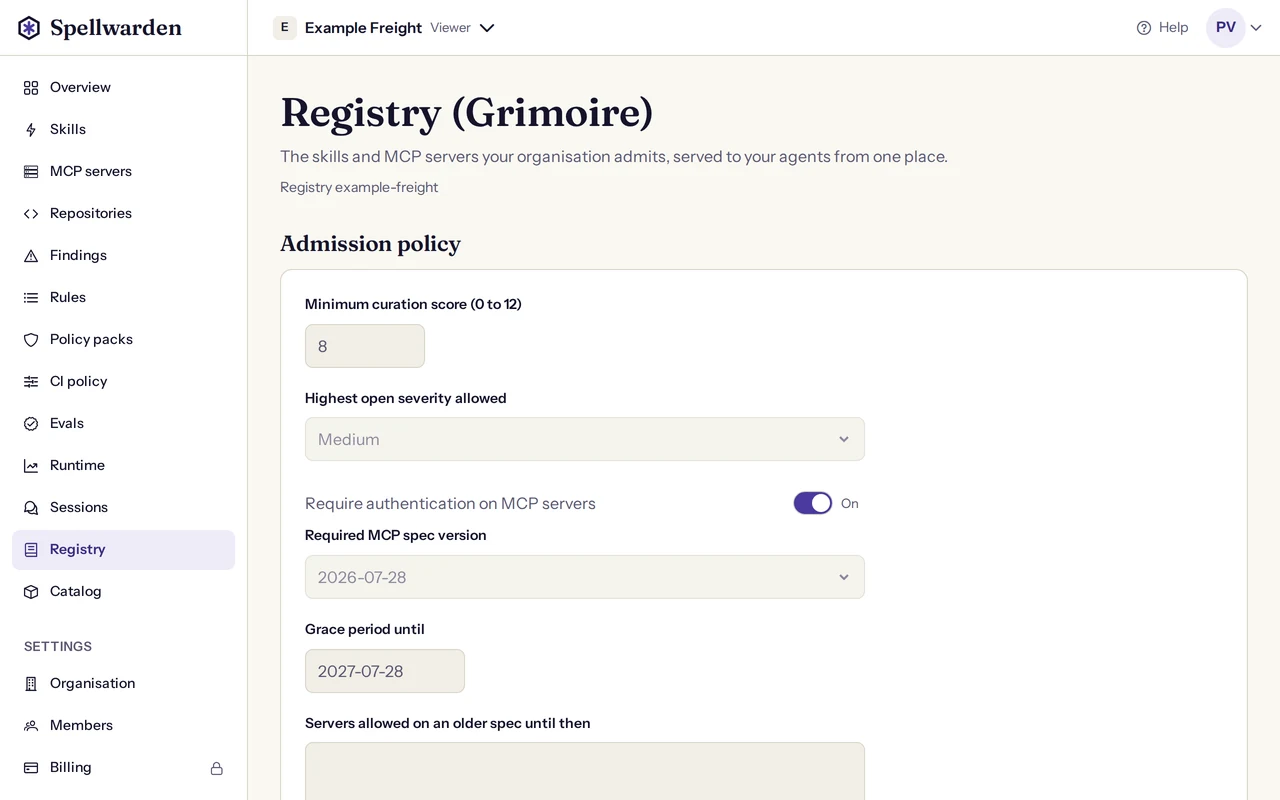
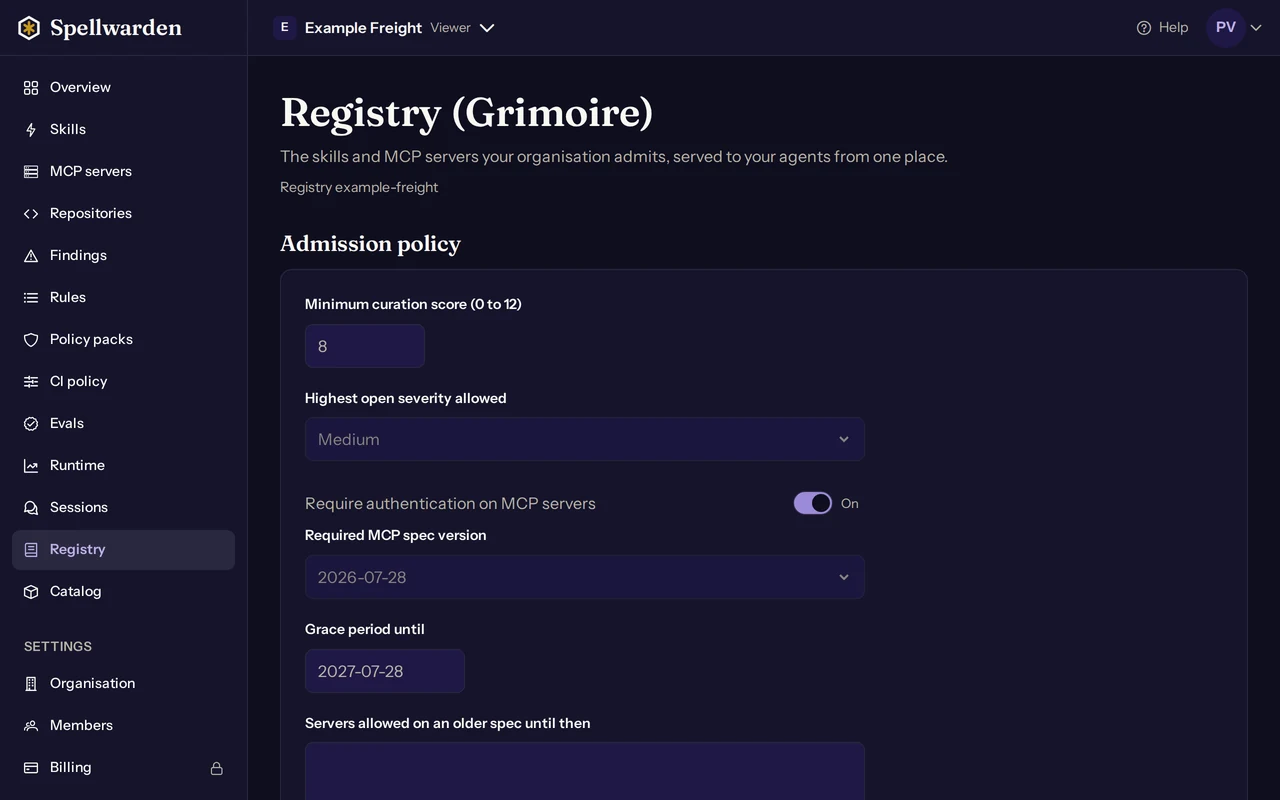
Every MCP server is probed against the 2026-07-28 MCP specification and gets an ordered migration checklist. What passes your policy enters your private registry, served as an MCP registry and as a Claude Code plugin marketplace.

  • Admission policy: minimum curation score, highest open severity, authentication required, and the spec version with a grace period (Enterprise)
  • Pull and merge requests checked against the registry: anything not admitted becomes a high finding with a link to request admission (Enterprise)
  • Allow entries for pinned commands, plugins and marketplaces, recorded by name in the audit log (Enterprise)
  • A trust score for the organisation, from security and migration
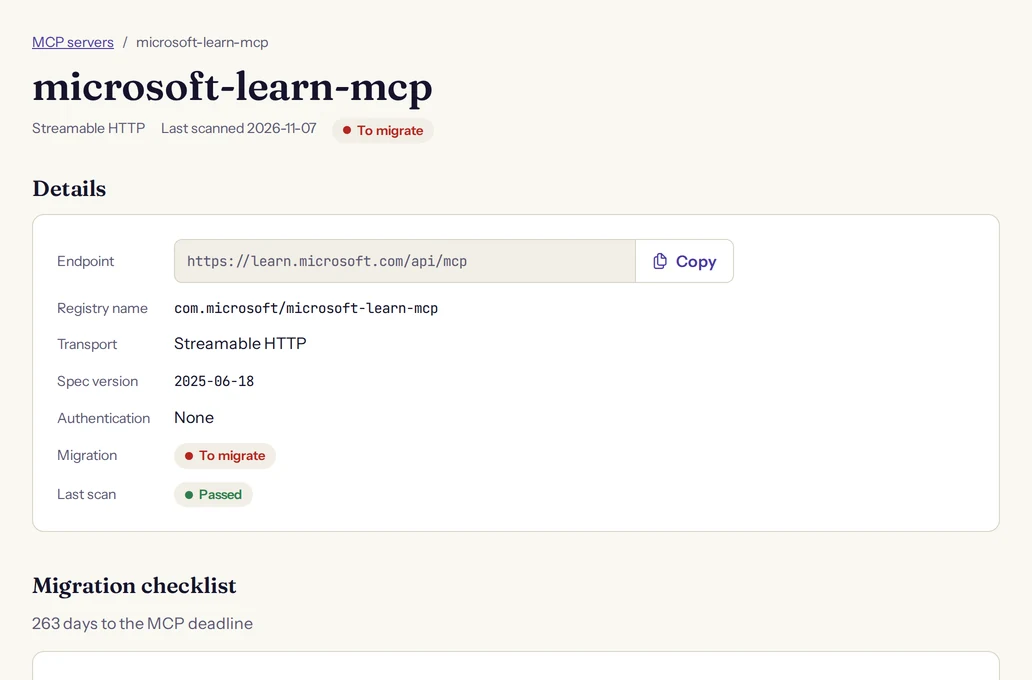
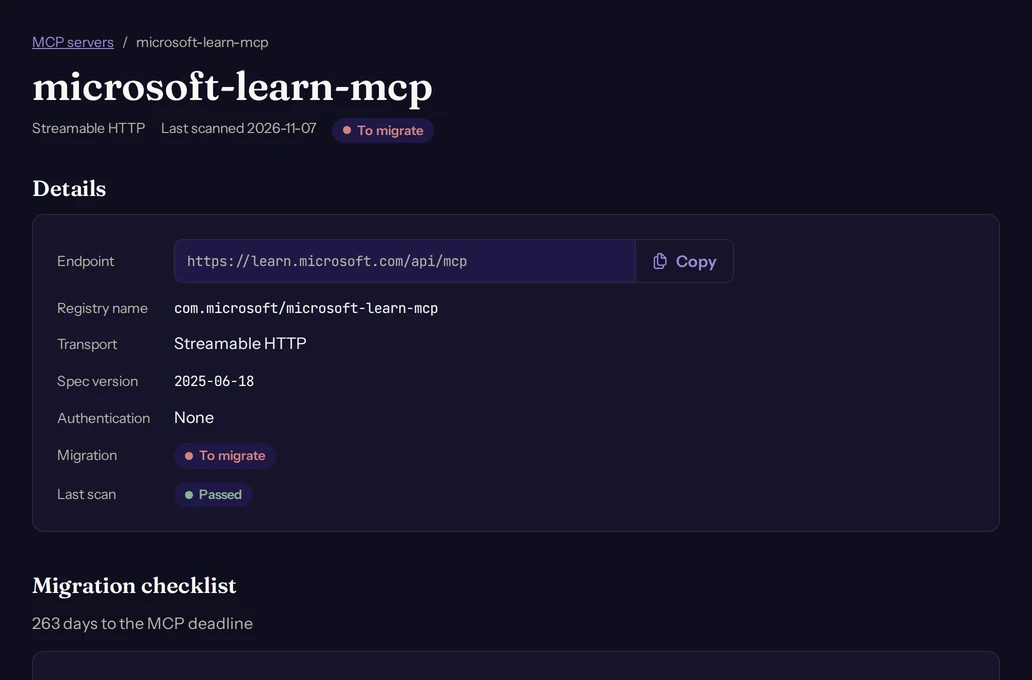
An MCP server's page: endpoint, registry name, transport, spec version, migration state and the start of its migration checklistAn MCP server's page: endpoint, registry name, transport, spec version, migration state and the start of its migration checklist

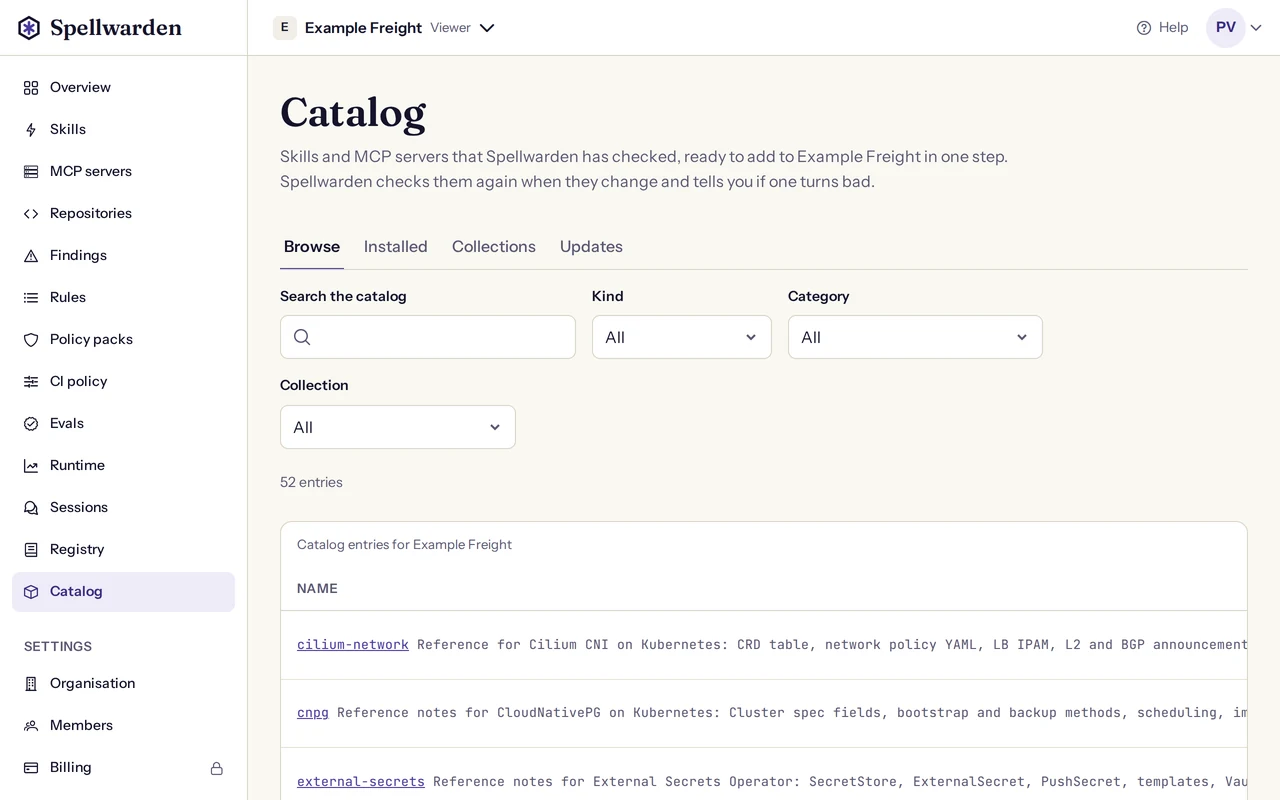
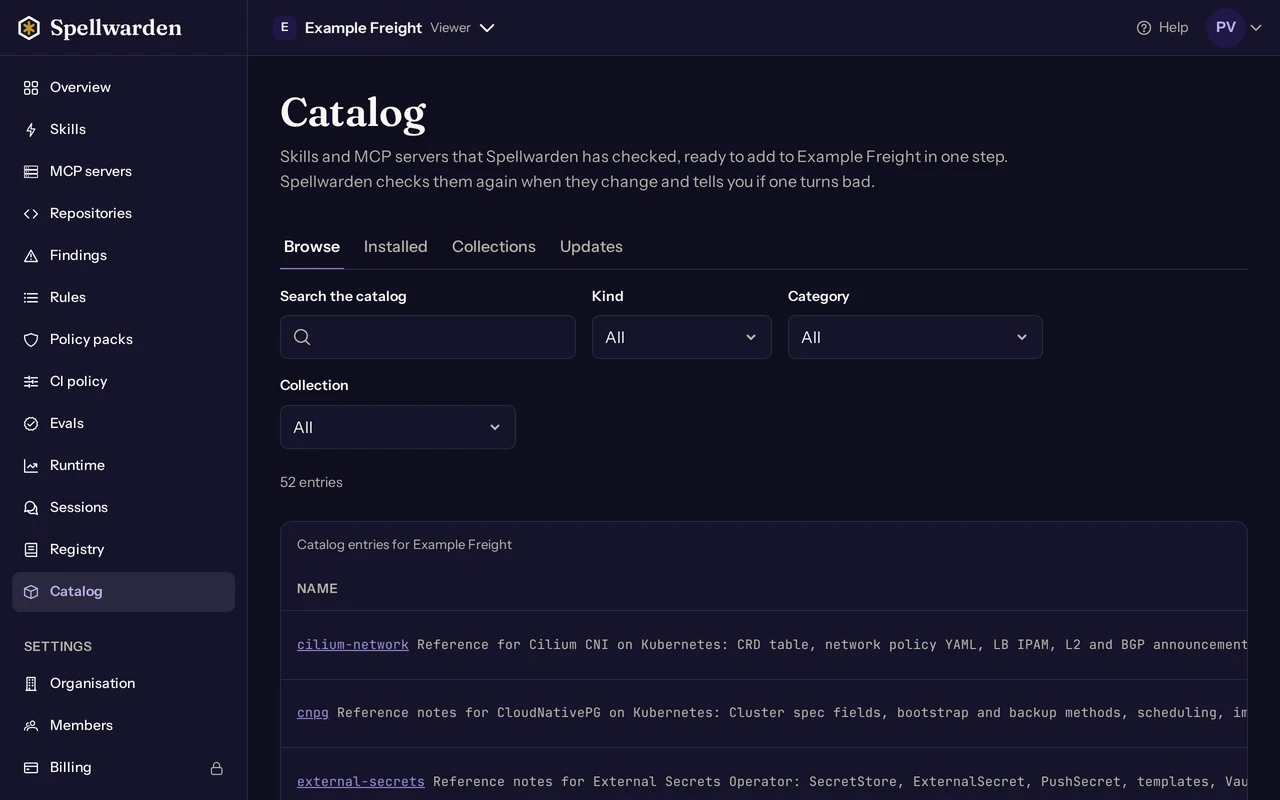
Catalog

Start from skills and servers we have already checked.

The Spellwarden catalog lists skills and plugins checked at a pinned commit, and MCP servers run by their vendors, each through a five-point check. Install one in a step; Spellwarden checks it again about once a day and after every scanner release.

  • 50 entries in 3 collections
  • Config for Claude Code, VS Code and Cursor
  • Alerts, advisories and email when a re-check fails; installs stay on their version until you update
  • Anyone can browse it at spellwarden.ai/catalog
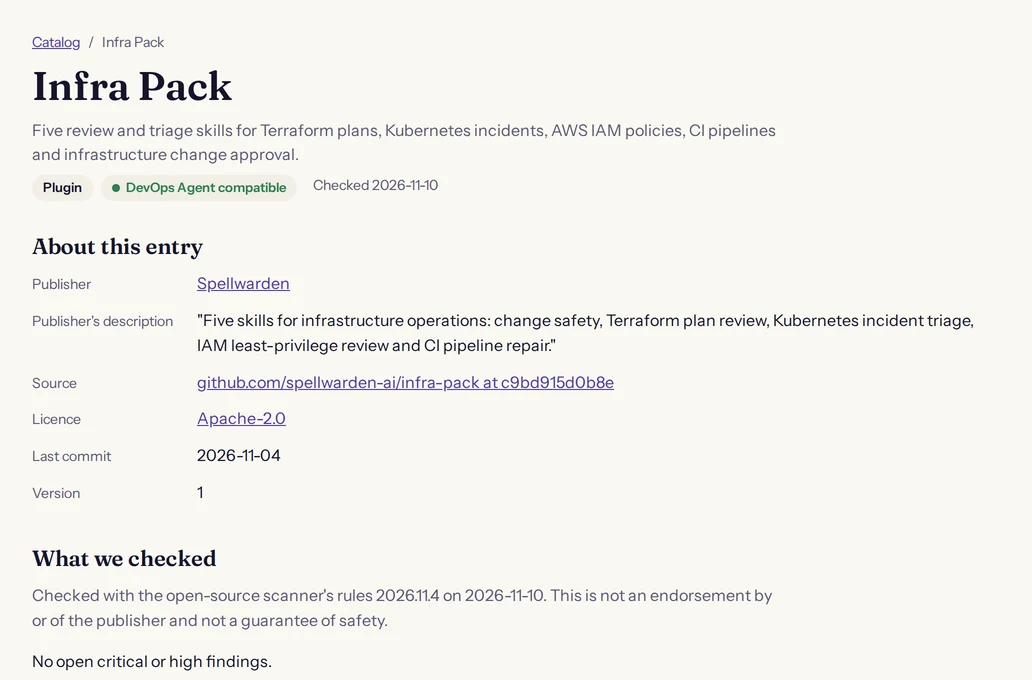
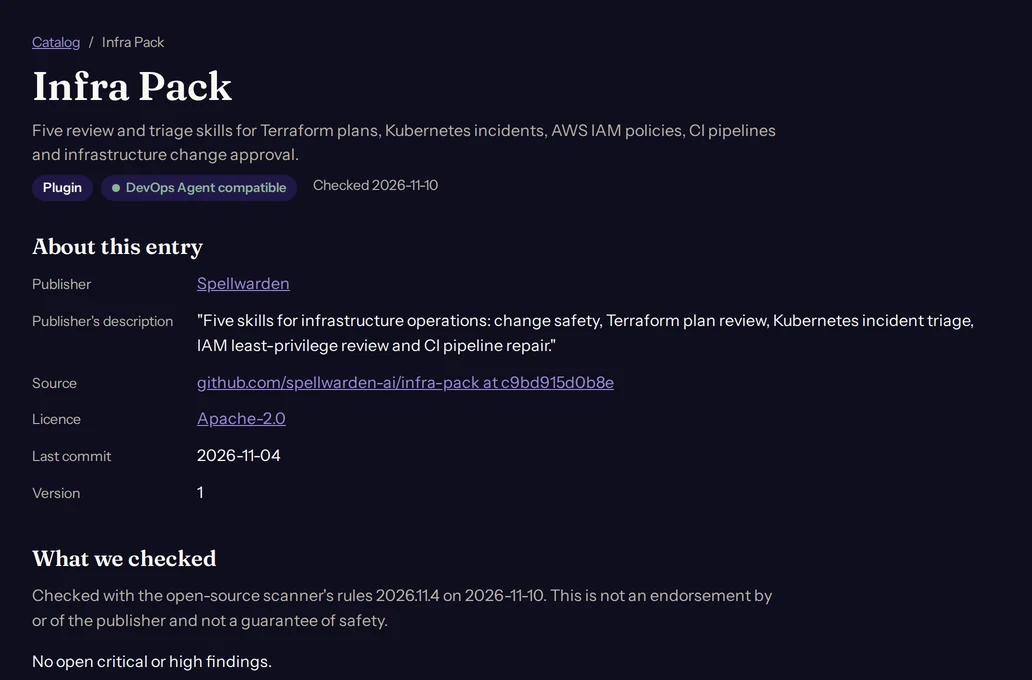
A catalog entry, the Infra Pack plugin: what the entry is, its source and licence, and what Spellwarden checked before listing itA catalog entry, the Infra Pack plugin: what the entry is, its source and licence, and what Spellwarden checked before listing it

Use Spellwarden from Claude

Connect Spellwarden to Claude or Claude Code with OAuth and ask in plain words: list open findings, scan a skill, start an eval run, export a policy pack. 19 tools, each acting with your own role. Scripts and CI use the API with read, write, CI and ingest keys.

Set up the Claude connector

Start with the open-source scanner

The Spellwarden scanner is Apache-2.0. Run it on your machine or in any CI. The GitHub Action and the GitLab component add code scanning alerts and a comment on each pull or merge request.

The Infra Pack, five Claude Code skills for infrastructure work, is open source too, and measured in the open.

$ spellwarden scan .
skills/terraform-apply
  high SW-SKL-007 skills/terraform-apply/SKILL.md:10 Remote script piped to a shell
  medium SW-SKL-012 skills/terraform-apply/SKILL.md:12 Reads a credential file path without stating purpose
  medium SW-SKL-019 skills/terraform-apply/SKILL.md:10 Fetches external URL content into context without an allowlist
  low SW-SKL-031 skills/terraform-apply/SKILL.md:1 Missing license and version metadata

4 findings (0 critical, 1 high, 2 medium, 1 low), 0 accepted; failed at high
Output of spellwarden 1.9.0

The migration ritual

The 2026-07-28 MCP spec removed sessions and the handshake. Its twelve-month deprecation window ends around 28 July 2027.

Read the migration guide

  • Up to five servers moved to the stateless spec, with OAuth
  • A migration report for each server
  • The result admitted to your private registry

A ten-day engagement, fixed fee, EU team.

Ends about 28 July 2027

Where the date comes from

Fixed-fee MCP migration

Book the ritual

Everything in Spellwarden

Every feature, with the plan it comes with. Open one for what it does.

Scan

Skill scanningTeam and Enterprise

Scans SKILL.md packages from a zip, a public repository, skills.sh or a plugin marketplace with 65 rules, pins each version by its hash, scores it from 0 to 12 and quarantines malicious ones.

Read the guide

MCP server checks and migration reportTeam and Enterprise

Probes a server against MCP 2026-07-28 and gives an ordered checklist ahead of the 28 July 2027 deadline; an unauthenticated tool list is rated low with no tool, medium when every tool is read-only and high otherwise.

Read the guide

Read the migration guide

Tool description gradesTeam and Enterprise

Grades up to 50 tool descriptions of a server from A to F, as one eval run.

Read the guide

A2A agent cardsAll plans

Checks agent cards with 19 rules for A2A 1.0 conformance, authentication flows, signed cards, injected text and credentials, and probes remote cards on request.

Read the guide

Weekly rescansTeam and Enterprise

Re-fetches skills from a repository, skills.sh or a marketplace and re-probes servers with an endpoint every 7 days.

Read the guide

FindingsTeam and Enterprise

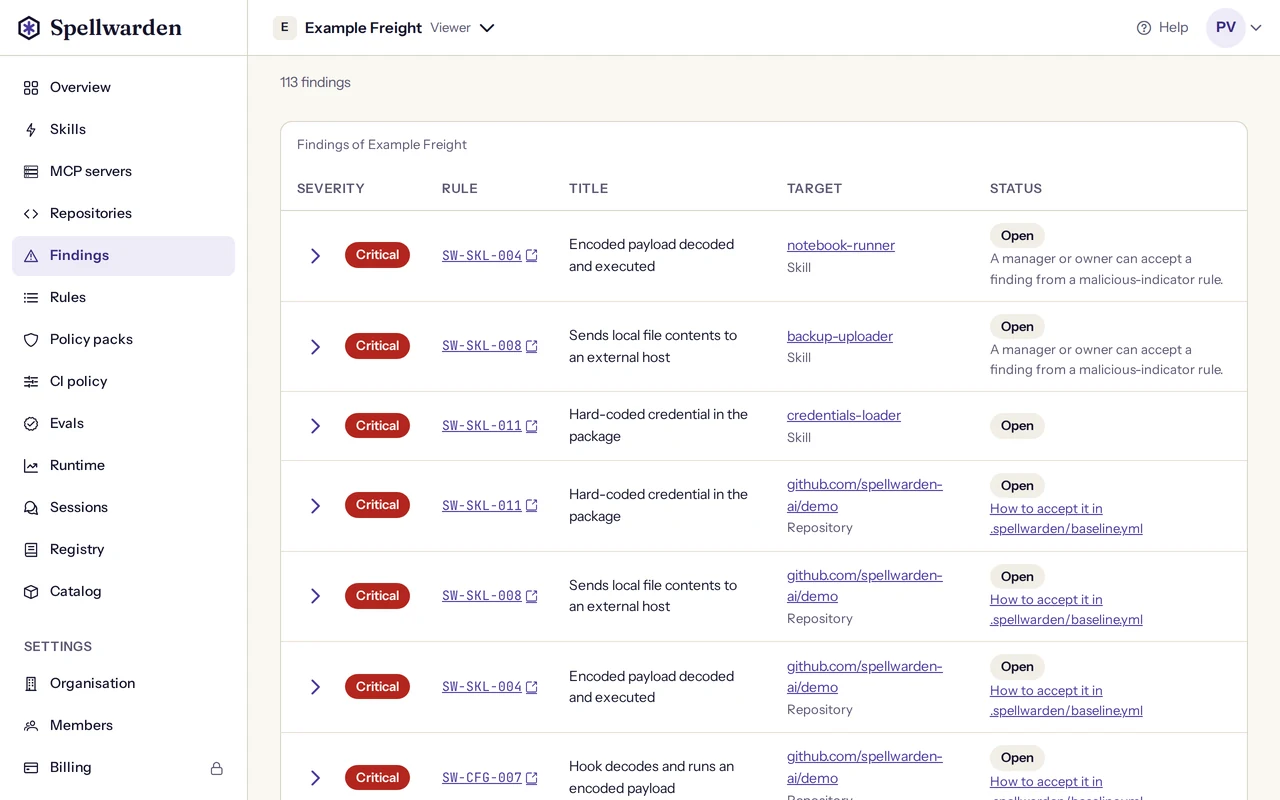
One list across skills, servers and repositories, with manual findings; accepting a critical or high finding needs a manager or owner.

Read the guide

Repositories and connected CITeam and Enterprise

CI uploads results; default-branch scans attested by OIDC are the repository's state, and pull and merge request scans of the last 30 days are listed.

Read the guide

Trust scoreTeam and Enterprise

Combines security at 0.4 and migration at 0.3; eval coverage is shown but not counted yet.

Read the guide

Policy

Baseline rulesAll plans

65 rules mapped to the OWASP Agentic Top 10, the OWASP MCP Top 10 and NIST SP 800-53, which is provisional.

Read the guide

Organisation rulesTeam and Enterprise

A manager promotes a finding into an SW-ORG rule that runs on every scan and in CI.

Read the guide

Share a ruleTeam and Enterprise

Opt in to share one organisation rule toward the public baseline, with a preview of what is sent.

Read the guide

Policy packsTeam and Enterprise

A baseline pack of 8 enforcement rules, and your own packs with published versions that never change.

Read the guide

Policy exportsTeam and Enterprise

Claude Code hooks (advisory in project mode, enforcing in managed mode), Kong and Zuplo MCP Gateway, each listing what it cannot enforce.

Read the guide

CI policyTeam and Enterprise

Sets which rules or pack CI applies, which packs a repository may name and how the registry check runs.

Read the guide

CI connectionsTeam and Enterprise

GitHub (github.com, Enterprise Cloud and Server) and GitLab (gitlab.com and self-managed), with an OIDC token swapped for a 15-minute CI token and pasted signing keys for private forges.

Read the guide

Registry check for pull and merge requestsEnterprise

Anything not admitted becomes a high finding (SW-REG-001 to 003) with a link to request admission.

Read the guide

Evals

Paired skill evalsTeam and Enterprise

Four sealed suites of 40 tasks answered with and without skills, reporting the lift in points with an interval; 20 runs a month, 3 in the trial, informational only.

Read the guide

Calibration statusTeam and Enterprise

The Suites tab shows each suite's calibration status; none is calibrated yet.

Read the guide

Session evalsTeam and Enterprise

Grades up to 50 sampled sessions on 6 criteria: tool choice, error handling, respecting denials, ignoring injected instructions, grounded outcome and staying in scope.

Read the guide

Eval exportsTeam and Enterprise

Zips for AWS AgentCore Evaluations, Microsoft Foundry and Outcomes in Claude Managed Agents: 4 sealed rubrics without tasks, 3 practice suites of 20, session and tool-description rubrics, and your own datasets.

Read the guide

Push to your accountTeam and Enterprise

AgentCore by role and external ID, Foundry and the Claude Platform by workload identity federation, with no stored secret.

Read the guide

Runtime

Runtime tracesTeam and Enterprise

OTLP over HTTP with an ingest key: servers, tools, skills, models and agents over 1 to 90 days matched to scans and findings, with 2 million records a month on Team and 20 million on Enterprise; matching to the private registry is Enterprise.

Read the guide

SessionsTeam and Enterprise

Records grouped into sessions, shown as a tree of agent, model, tool and decision steps.

Read the guide

Content storageTeam and Enterprise

An owner can turn on storage of prompts and tool arguments, kept masked for 30 days and readable by owners and managers.

Read the guide

Registry and migration

Private registryEnterprise

Admits what passes your policy (by default a score of 8 or more, nothing open above medium, authentication required, spec 2026-07-28 with a grace period to 28 July 2027), served as an MCP registry and a Claude Code plugin marketplace.

Read the guide

Read the migration guide

Allow entriesEnterprise

Admit a pinned command, plugin commit or marketplace commit, recorded under a person's name in the audit log.

Read the guide

Catalog

Public catalogFree

Skills, the Infra Pack plugin and vendor-run MCP servers, each through a five-point check: a passed scan at a pinned commit, Curated, an allowed licence, maintained, and for servers a vendor HTTPS endpoint.

Read the guide

Install and re-checksTeam and Enterprise

One-step install at a pinned commit with config for Claude Code, VS Code and Cursor; each entry is re-checked about once a day and after every scanner release, with alerts, advisories and email.

Read the guide

Integrations and API

Claude connectorTeam and Enterprise

An MCP server with OAuth at dash.spellwarden.ai/api/v1/mcp with 19 tools (14 read, 5 write) that act as you, for Claude on the web, desktop and mobile and for Claude Code.

Read the guide

AWS DevOps AgentTeam and Enterprise

One open-source CloudFormation stack per Agent Space: Spellwarden scans the skills, AGENTS.md files, custom agents and MCP servers it loads every hour, can switch off failing skills and install vetted catalog skills, and adds 13 read-only tools.

Read the guide

API and keysTeam and Enterprise

The v1 API with read, write, CI and ingest keys: up to 20 read or write keys, 200 CI keys and 20 ingest keys, at 300 requests a minute.

Read the guide

Accounts and security

Accounts and organisationsTeam and Enterprise

Email and password or Google sign-in; one account can belong to many organisations; email invitations are valid for 30 days.

Read the guide

RolesTeam and Enterprise

Owner, Manager, Member, Viewer (read-only) and Billing.

Read the guide

Two-factor sign-inTeam and Enterprise

Anyone can turn on TOTP, and owners can require it.

Read the guide

Single sign-onEnterprise

SAML or OIDC on top of accounts, which can be required.

Read the guide

Audit logEnterprise

The organisation's activity record.

Read the guide

EU hostingAll plans

AWS Frankfurt, with evals on Amazon Bedrock EU profiles.

Read the guide

Live demoFree

A read-only organisation with no sign-up, reset every night.

Read the guide

Open source

ScannerFree

spellwarden 1.9.0, Apache-2.0, with 65 rules; SARIF, JSON, markdown and GitLab Code Quality output, lock and baseline files, the MCP probe, connected mode and a signed container image.

Read the guide

GitHub Action and GitLab componentFree

Version 1.9.0 adds code scanning alerts, a pull or merge request comment and failing at a chosen severity; on GitHub Marketplace and the GitLab CI/CD Catalog.

Read the guide

spellwarden otel normaliseFree

Shows offline what Spellwarden would keep from a telemetry file.

Read the guide

Infra PackFree

Five Claude Code skills as a plugin marketplace; version 0.9.0 measured +15.0 points (95% interval 3.6 to 26.4).

Read the guide

Pricing

Per member, with a minimum of 10 members on Team and 50 on Enterprise. No seat cap.

Billing period

Cantrip

Free tier

Free

The open-source scanner, its GitHub Action and GitLab component, and the Infra Pack, Apache-2.0.

  • Command line scans with 65 rules, on your machine or in CI
  • GitHub code scanning and GitLab Code Quality reports
  • Infra Pack skills for Claude Code
  • Browse the Spellwarden catalog
Install the scanner

Enterprise

EUR 10 per member per month, before VAT

Billed monthly.

Minimum 50 members: from EUR 500 a month.

For organisations that must show evidence.

  • Everything in Team
  • Single sign-on (SAML or OIDC)
  • Private registry, with allow entries
  • Pull and merge requests checked against the private registry
  • Runtime traces: 20 million records a month, matched to your registry
  • Audit log
  • Support with a response-time commitment
Start with Enterprise

Starts as a 14-day trial of Team. Upgrade to Enterprise from Billing.

On-premise

Your environment

On request

Spellwarden deployed in your own environment, for organisations that cannot use a hosted service.

  • Deployed where you need it
  • Scope and price agreed with you
Talk to us

We scope each on-premise deployment with you.

Every new organisation starts with a 14-day trial of the Team plan. If no billing is added by the end, it becomes read-only and keeps its data until billing is added.

Sign in with Google or with email and password on every plan and during the 14-day trial.

Creem is the seller of record and issues your invoice.

See every screen before you sign up

The live demo is a working organisation in the real product: scans, findings, eval runs, runtime and the catalog. Read-only, reset every night, no account needed.